
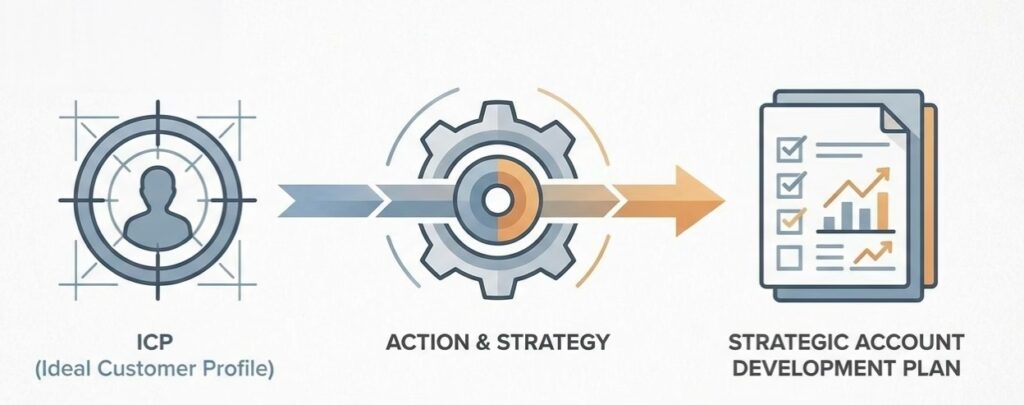
Part 3: From ICP to Action—Building Your Strategic Account Development Plan
- The Complete ICP Profile: Going Deeper
In Part 2, you identified your target vertical and created a basic ICP. Now we’re going to make it surgical.
Your Deep-Dive ICP Worksheet
Developing an ICP is critical to adding net new customers. According to Hubspot, companies with a strong ICP sales process boast a 68% higher win rate than their competitors. This is because they better understand their business prospects and their unique requirements within the scope of products and services they offer. With a solid ICP we can create a go-to-market for that segment and your business generation plan and budgets.
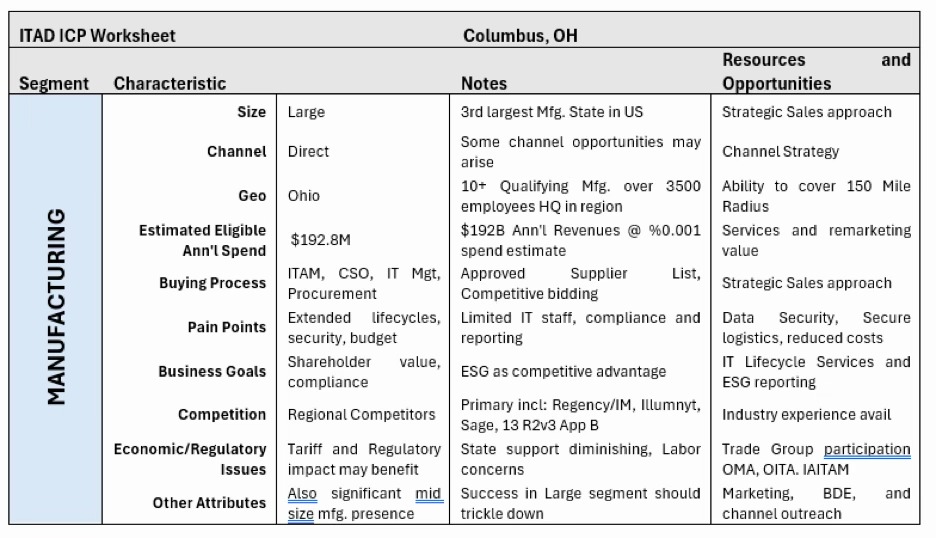
Using an example of an ITAD based in Columbus OH, the initial SWOT analysis identified opportunities and weaknesses in 2 critical segments, Manufacturing and Insurance, where Ohio ranks 3rd and 6th nationally. Previously this ITAD had no particular focus on any industry segment, except for a handful of primary customers that happened to be tech and finance firms. The ITAD determined that Manufacturing and Insurance should be a growth focus, and first built the following ICP for the manufacturing sector:
New Business Generation plan: At this point, we like to develop a summary plan to attack the new ICP we’ve developed so we know how to best convert our current weaknesses into opportunities and strengths. New resources and deliverables to reach the key customers in this segment will be needed and we should also make budgeting assumptions to gain agreement amongst the leadership team.
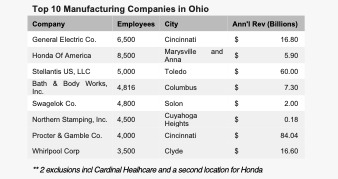
Top Prospects list:. First we should understand the actual companies we’ll be calling on as top new prospects. Using public data we identified the top Ohio Manufacturing companies by headcount as follows:
Creating the Plan with strategic accounts in mind: A plan to target and grow the business within these Top 10 manufacturing companies is necessary. This step takes work and cooperation amongst the leadership team. It may be best to assign this step to a particular member of the team to submit for comment and approval. Some companies at this phase may decide that they can hire an experienced salesperson in this segment to meet the goal. While this has merits, this strategy is too dependent on the success of one individual. And if the rest of the business is not doing anything different to support the new hire, he/she will be swimming upstream and is highly likely to struggle or fail. If budget and resources allow, it’s better to pursue a broad strategy for success that includes all aspects of the business.
| Strategic Account Development Plan Summary | Columbus, OH | |||
| Segment | Activity | Department | Actions | Notes |
| MANUFACTURING | Executive Team | Allocate Budget | Set Yr 1 Annual Operating Plan (AOP) | Sales, Marketing, Product Development budget |
| Sales Leadership | Sales Leadership | Set Sales AOP | SQL planning, Sales staff and budget | |
| Marketing | Marketing | Develop Marketing plan | MQL planning, marketing staff and budget | |
| Product Development | Executive, Sales, or Project Lead | Onboard new deliverables for segment | Services Budget | |
| Compliance | Compliance and Quality Lead | Reporting and Compliance Requirements | ||
Hot Take: Most ITADs underfund new vertical development by 50-75%. Then they wonder why it doesn’t work.
Here’s some suggestions for more detailed planning.
- Add at least 1-2 unique deliverables:
- ESG Reporting
- Asset Management Integrations
- Other unique lifecycle services
- Develop a strategic selling capability:
- Can be sales leadership to start
- Hire industry experienced BDE
- Invest in Strategic sales training for leadership, marketing and sales team to harmonize your outreach efforts
- Plan specifically for how to develop both Marketing and Sales Qualified leads (MQL/SQL)
- Create an AOP or proforma P&L that includes all sales, marketing, and product development expenses and staff costs. Key assumptions may include:
- Year 1 revenue budget should be limited mos. 1-6.
- New account acquisition costs are typically 10-20% of annual rev$
- Profitability can take 24-36 mos. It’s a startup business.
With a solid plan in place to dominate in the chosen segment- we can update our SWOT Analysis to include some new comments as shown below:
| ITAD SWOT Analysis Example | ||
| Strengths | Leading provider of ITAD services to Manufacturing companies | |
| Weaknesses | Limited Brand Awareness | |
| Opportunities | First mover and Leadership in the $200M annual market opportunity among Midwest manufacturing companies | |
| Threats | Copycat competitors | |
As of the writing of this article, an examination of the leading R2v3 ITAD’s in Ohio demonstrates no particular industry vertical focus on Manufacturing, Healthcare, or Financial/Insurance services. This speaks to the awesome opportunities available to ITAD’s that can focus their message as a self-proclaimed leader to the needs of a particular industry segment via the ICP based planning process.
- What’s Next: Part 4 Preview
You now have some ICP’s and improved SWOT analysis complete, along with a start on your strategic account development in mind.
Coming in Part 4, we’ll look at a plan to open new accounts with: Develop a powerful Inside Sales Lead Generation Machine
✅ Inside Sales vs Inside Lead Generation vs Outside Sales lead Gen
✅ Technology enablers
✅ Training and mentoring specific to the ITAD and IT reseller
Questions? Comments? War stories?
Drop a comment below or email us at pete@circmo.com. We read and respond to every single one.
Want personalized help restructuring your sales team?
Book a free 30-minute strategy call. We’ll diagnose your biggest bottleneck and give you a custom roadmap.
Circular Momentum helps ITADs develop and implement growth strategies that outpace the competition. Also be sure to check out our other playbooks on Marketing and Lifecycle Services development for high technology businesses – ask us for a copy.
Next in the series: Part 4: Develop a powerful Inside Sales Lead Generation Machine