
Part 4: Develop a Powerful Inside Sales Lead Generation Machine
The Evolution of Your Sales Team
Remember when your founder did everything? Prospecting, selling, closing, even loading the truck. Those were simpler times. But as your ITAD business grows past the startup phase, trying to do it all becomes unsustainable.
As revenue scales toward 5 to 10 million annually, sales structures must evolve.
| Stage | Key Change | Example of Shift |
| 1. Solo Salesperson | Ad hoc process | Founder-led outreach |
| 2. Small Team | Basic specialization | Intro of CRM and lead sharing |
| 3. Scaling Team | Defined roles and KPIs | SDRs and AEs introduced |
| 4. Mature Org | Structured management and analytics | Forecasting & dashboards |
| 5. Enterprise Org | Global segmentation & integration | RevOps and strategic accounts |
Early Stage Founder Led
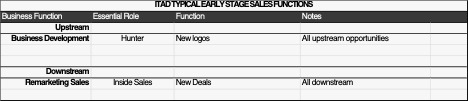
In the early days, one individual hunts inbound business and closes deals. Purchasing may play a key role if they understand market valuations.
Eventually, work splits naturally:
Upstream focuses on hunting new packages and winning net new customers.
Downstream focuses on transactions and closing deals.
Early Stage Growth and Specialization
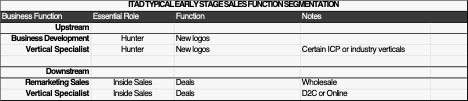
As growth continues, new sales resources are added for specialization.
Upstream may add someone focused on channel partners or SLED business.
Downstream may add an online sales manager.
Mid Stage Expansion: The Support Layer
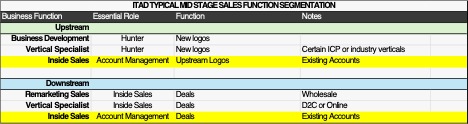
Support functions emerge to assist senior sales staff.
Inside sales roles may handle quoting so senior reps can focus on hunting. Titles vary such as SDR, BDR, or AE.
Mid Stage Expansion II: Increased Specialization and Admin Functions
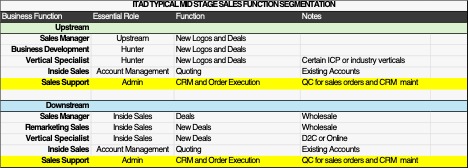
Sales administration becomes critical.
Sales support enters orders for quality control.
They assist with quoting and CRM management.
These roles often sit within inside sales.
The Critical Decision Point: Solving the Lead Generation Crisis
Eventually, sales becomes starved for new quality leads. Growth targets cannot be met without reliable net new opportunities.
Traditional approaches fall short.
Hunter Generated Leads
Hunters perform well early on, but once they build a book of business, new logo generation slows. Hiring new hunters can help but creates its own challenges.
Inside Sales Leads
Inside sales teams are typically farmers, not hunters. They focus on account growth, not scalable net new acquisition.
Marketing Provided Leads
Marketing can generate MQLs, but it requires heavy investment and rarely delivers the volume and quality needed alone. Marketing should support sales, not replace it.
The Solution: Build a Dedicated Lead Generation Machine
There is one proven way to sustain growth: develop an inside sales function focused strictly on lead generation.
What Does Not Work
Hiring low wage telemarketers
Minimal training and generic scripts
High dial quotas
Low quality leads
No structured follow up
This approach wastes years.
What Does Work: The Winning Formula
Success rests on nine pillars:
Strategic Hiring
Intensive Mentoring
Comprehensive Training
Additional Ongoing Training
Competitive Compensation
Crafted Offers
Omni Touch Outreach
SQL Metrics
The Right Tools
Strategic Hiring: Finding Raw Talent
Hire talented individuals without prior full time experience and train them properly.
Look to trade schools, community colleges, universities, and career technical programs.
Use structured hiring with consistent scoring criteria. Seek raw talent interested in technology and sales careers.
Training: Build Your Mini University
Dedicate 75 percent of onboarding to training. Develop permanent internal curriculum assets.
Core training for ITAD sales should include:
Understanding the prospect’s IT environment
Server, storage, and end user technologies
IT asset management and lifecycle services
User support environments
IT security principles
Corporate finance and leasing
Technology refresh cycles and TCO
Service models such as DaaS, HaaS, SaaS, IaaS, cloud
ESG and carbon accounting
Data privacy laws such as HIPAA and GDPR
Corporate IT organizational structures
CxO roles and governance structures
Mentoring: The 25 Percent That Makes the Difference
At least 25 percent of training should be mentoring.
Initial phase
One hour per day discussing lead generation strategies
Mid term
Four hours per day side by side calling led by mentor
Final phase
Four hours per day led by trainee with mentor support
Competitive Compensation: Pay to Win
Compensation must be competitive.
As a benchmark, enterprise trainee roles often earn around 65,000 per year. Approximately 30 percent should be commission based, achievable by average performers. High performers should earn more.
Crafted Offers: Give Them a Reason to Talk
Generic meeting requests fail. Develop compelling, value driven offers aligned with prospect pain points.
Examples include savings analyses, white papers, webinars, free assessments, or specialized solution reviews.
Move beyond generic ideas and create offers that highlight your unique value.
Omni Touch Outreach: Multi Channel Engagement
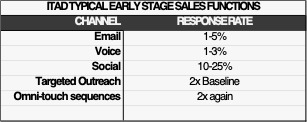
Use structured outreach across phone, email, social media, and indirect marketing. Multi touch programs increase conversion rates.
SQL Metrics
What kind of response rates you should expect for generating SQL’s (Sales Qualified Leads) are based on many factors, like the quality of your offering and the creativeness of your scripted approach. Here’s some industry benchmarks for enterprise outreach that can be used for planning purposes:
The Right Tools: Infrastructure Matters
Quality data sources such as ZoomInfo, Apollo, Seamless AI, and LinkedIn Sales Navigator support prospecting efforts.
Small teams can begin with a single license managed centrally.
Before launching, ensure:
A functioning CRM
Strong data integrity protocols
Documented business rules
Dedicated sales admin oversight
The Bottom Line
Lead generation is the starter motor of your organization.
Founder generated leads are unreliable and exhausting.
Marketing alone is insufficient.
A dedicated inside sales lead generation machine creates dependable, scalable growth.
Invest in the right people, processes, and tools. Build a system that consistently identifies and qualifies new customers.
Questions or comments? Email pete@circmo.com
Circular Momentum helps ITADs develop and implement growth strategies that outpace the competition. Explore additional playbooks on Marketing and Lifecycle Services development for high technology businesses.
Next in the series: Part 5: Sales Funnel