
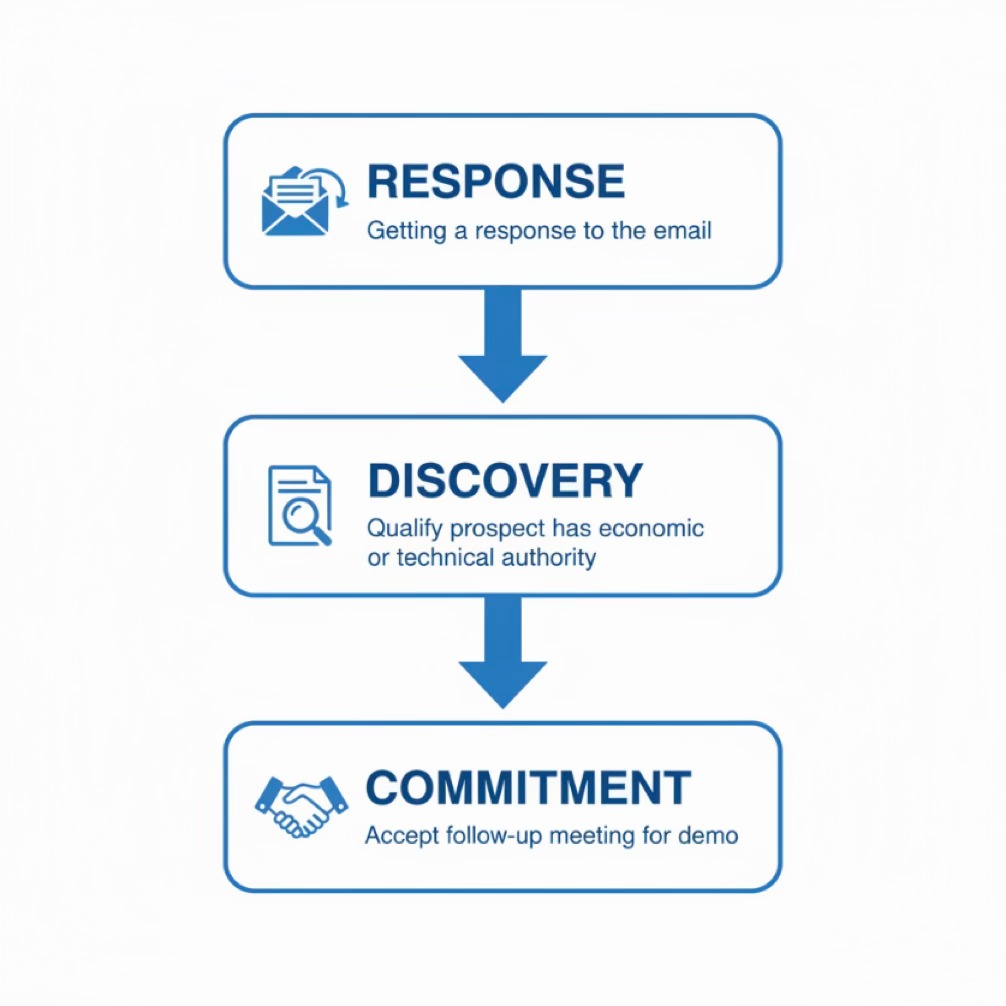
The Next Steps in the Lead Generation Journey
In the previous section, we explored tactics for cold outreach emails designed to generate responses from prospects so we could begin qualifying them.
In this section, we move to the discovery process—a structured Q&A conversation that helps determine the prospect’s role in the decision-making process for IT-related services such as IT Asset Disposition (ITAD). We will also review how to structure the first sales call and presentation.
Once a prospect is identified as someone who may influence or authorize ITAD vendor selections, the natural instinct is to immediately start pitching your services. However, this should be avoided.
Discovery must come first.
Before presenting your services, you need to understand whether the prospect is truly the qualified buyer and how their organization’s decision process works.
The Elevator Pitch
If the prospect asks about your company before discovery is complete, provide a short elevator pitch and transition back to questions.
Example:
“As I mentioned upfront, ACME ITAD is an R2v3 and ISO-certified ITAD provider that helps enterprise customers securely dispose of end-user and data center equipment.”
Then ask:
“Before I tell you more about ACME, would you mind if I ask a few questions so I can better understand your needs?”
Step 1: Discovery
The goal of discovery is to confirm how the prospect’s organization makes decisions regarding ITAD services.
In some cases, prospects may be reluctant to share information. If that happens, you may not be able to qualify them properly.
Discovery primarily focuses on identifying all the actors involved in the decision-making process.
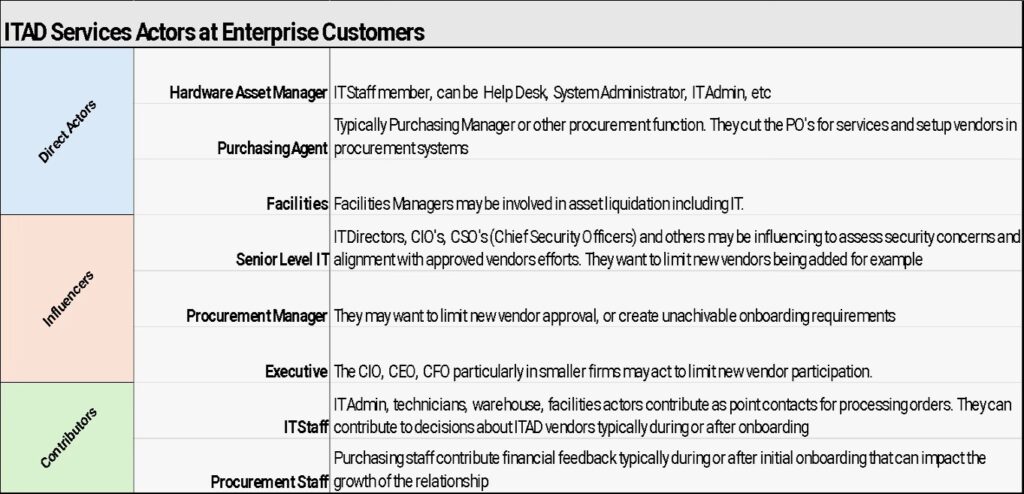
Identify the Key Actors in ITAD Decisions
When qualifying a lead, you need to identify three types of participants:
Direct Actors
These are the people directly responsible for choosing ITAD vendors.
Examples include:
- Hardware Asset Manager (HAM)
- IT Asset Manager
- IT Manager or Infrastructure Manager
Influencers
These individuals may not directly select vendors but can influence decisions.
Examples include:
- IT Directors
- CIOs or Chief Security Officers
- Facilities managers
Contributors
These roles participate later in the process or influence operational aspects.
Examples include:
- Procurement staff
- Purchasing agents
- IT technicians or warehouse staff
Understanding these roles ensures that your proposal addresses all stakeholders involved in the ITAD process.
How to Identify the Decision Makers
The best way to identify the actors is simple:
Ask questions during discovery.
Below are some effective discovery questions.
1. How do you process end-of-life IT equipment today?
This is often the best starting question.
Example prompt:
“Can you walk me through how your organization handles end-of-life IT equipment today?”
Follow-up questions might include:
- Do you typically prepare a list of assets before pickup?
- Do vendors provide an audit after receiving the equipment?
- Do you currently use a specific ITAD vendor?
- What do you like about working with them?
- Do you wipe data internally, or rely on the vendor?
- What security expectations do you have from ITAD vendors?
- Do you receive serialized asset lists and certificates of destruction?
These questions reveal how the process works and who participates.
2. What Does Your IT Refresh Cycle Look Like?
Many mid-size companies do not have a formal refresh cycle.
If that is the case, follow up with:
“Is the process more project-driven? For example, during major upgrades like operating system migrations?”
You can then ask about different asset categories:
- Laptops and desktops
- Data center equipment
- Servers
- Storage
- Networking hardware
- Mobile devices
This helps estimate asset volumes and potential opportunities.
3. Does Procurement Need to Approve Vendors?
Another key discovery question is whether finance or procurement must approve vendors.
Example question:
“Is there someone in procurement or finance I should speak with before providing a proposal?”
In many companies, the IT department selects vendors while procurement handles purchasing approvals.
Determine If Other Departments Are Involved
Sometimes IT is not the only department managing assets.
You should ask:
- Does facilities handle any equipment disposal?
- Do other departments manage their own IT assets?
- Are security teams involved in vendor approval?
These insights ensure your proposal aligns with all internal stakeholders.
Handling Common Discovery Challenges
When Prospects Refuse to Answer Questions
If the prospect does not engage in discovery, it becomes difficult to qualify them.
In this case, try asking:
- “Is your company open to evaluating new ITAD vendors?”
- “Would it make sense for me to speak with someone else about this process?”
If they cannot provide clarity, it may be best to pause the process rather than waste time.
When Companies Have a Vendor Bid List
Many larger companies maintain approved vendor lists.
If a prospect says:
“We only work with vendors on our bid list.”
Then your goal should simply be:
Get on the list.
Once approved, you can build the relationship over time.
When Prospects Ask Too Many Questions About Your Services
Prospects often try to reverse the conversation and ask you to present your services before discovery.
Redirect politely by saying:
“I’d like to gather a little more information first so I can tailor the presentation to your organization.”
Or:
“Can I ask just a few more questions so I understand your process better?”
This keeps the conversation focused on qualification instead of selling.
Setting Up the Presentation
After completing discovery and confirming the prospect is a qualified decision-maker, you can schedule a formal presentation.
It is recommended that you schedule the presentation for a separate meeting.
You can position it like this:
“I’d like to bring one of our specialists who handles technical presentations so we can walk you through our process in detail.”
Making the presentation a separate event increases the chance of engagement and signals serious buying interest.
Promotional Offers for New Prospects
To encourage prospects to attend presentations and begin working with your company, consider offering introductory promotions.
Example Promotions
Free Services for the First 3 Months
- Free equipment pickup
- Free data wiping for up to 500 devices
- Service Level Agreement guarantees
Advanced Offers
- Free asset valuation analysis
- Benchmarking pricing for previous asset lists
These incentives reduce risk and encourage prospects to test your services.
Final Thoughts
Qualified lead development is a critical step in turning cold outreach into real sales opportunities.
Rather than rushing into presentations, the focus should always be on discovery and qualification first.
By identifying decision makers, understanding internal processes, and structuring the conversation effectively, sales teams can dramatically improve their success in converting leads into long-term customers.
If you have questions, feedback, or your own experiences to share, feel free to reach out.
Circular Momentum helps ITAD companies build scalable sales systems and growth strategies that outperform the competition.
You can also request their additional playbooks on technology marketing and lifecycle services development.