
There is a widely shared assumption in the ITAD industry that enterprise IT organizations — the large, sophisticated, well-resourced companies that represent the most attractive customer segment — have their asset retirement programs figured out. They have IT departments. They have procurement teams. They have sustainability commitments in their annual reports. Surely they have a process.
The data says otherwise.
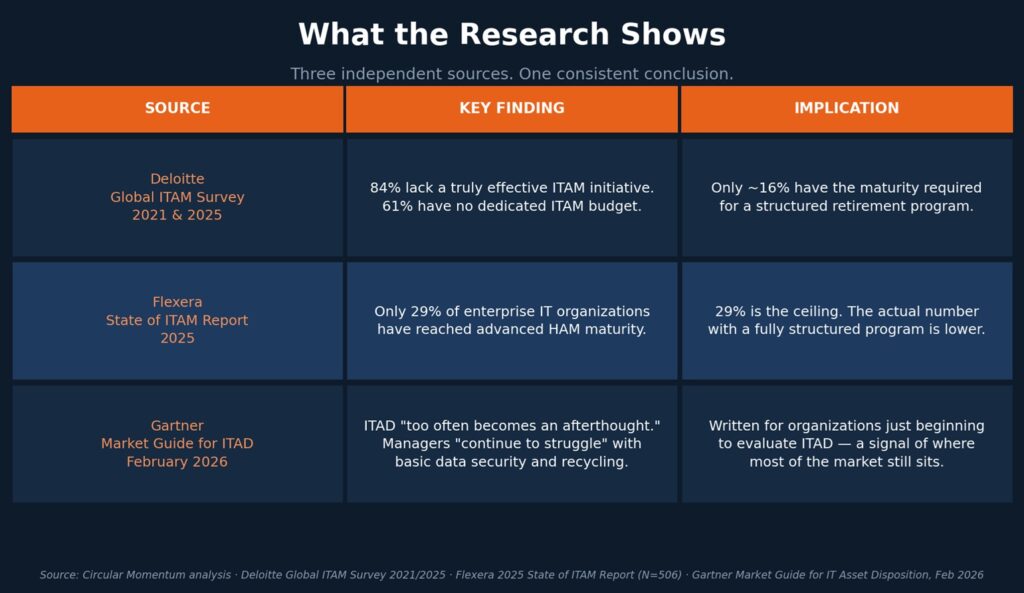
A new analysis of published research from Gartner, Deloitte, and Flexera — three of the most credible voices in enterprise IT management — points to a consistent and sobering conclusion: fewer than 25% of enterprise IT organizations are operating what could reasonably be called a structured IT asset retirement program. The remaining 75% are managing the end of their technology assets’ lives in ways that range from loosely organized to entirely ad hoc.
This is not a minor operational gap. In an environment defined by accelerating hardware refresh cycles, mounting data security obligations, growing ESG reporting requirements, and billions of dollars in unrealized asset value sitting in storage rooms and IT closets, the absence of a structured program is a material business risk. And for ITAD operators, it represents the single largest and most underserved opportunity in the market today.
This is Episode 1 of a two-part series. Here we make the case that the problem is real, widespread, and largely invisible to the organizations experiencing it. In Episode 2, we introduce the Circular Momentum Framework for Structured IT Asset Retirement — a set of six criteria that define what a structured program actually requires, and what it means for ITAD operators when a prospect doesn’t have one.
What the Research Actually Shows
No single study has asked enterprise IT leaders directly: “Do you have a structured IT asset retirement program?” That question, framed that way, has never been put to a large-scale sample. But three independent research streams — each measuring different dimensions of IT asset management maturity — tell a remarkably consistent story when read together.
The Deloitte Finding: 84% Lack a Truly Effective ITAM Practice
In 2021, Deloitte published the largest global IT Asset Management survey on record — 2,500 respondents across 18 countries, with nearly one-third at the C-suite or senior management level. The headline finding was stark: 84% of respondents said their organization lacks a truly effective ITAM initiative. Only 16% considered their program truly effective.
Deloitte has repeated this survey twice since — in 2022-23 and again in 2025. The maturity picture has improved at the margins but the structural gaps remain. The 2025 edition found that fewer than 40% of organizations have fully adapted their ITAM processes to support today’s hybrid IT environments. The majority still cannot fully account for what they have — let alone what to retire, when, and how.
The finding that most directly supports our argument: 61% of respondents had not made ITAM a self-funded initiative — meaning the majority of organizations have never established a dedicated budget for IT asset management at all. No budget, no program.
The Flexera Finding: Only 29% Have Reached Advanced HAM Maturity
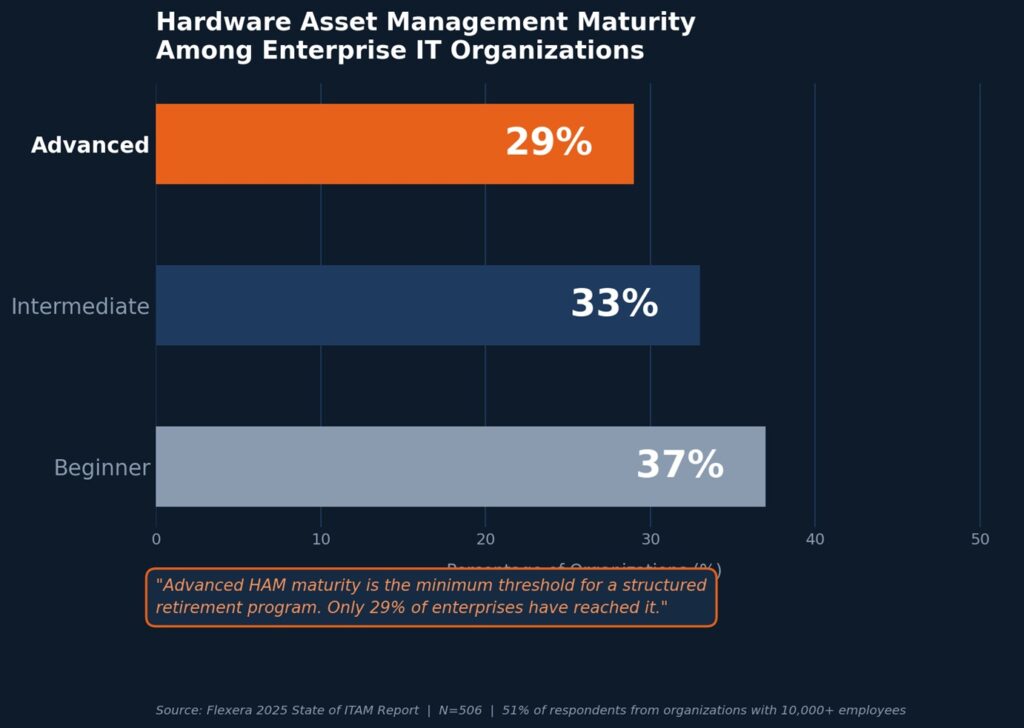
Flexera’s 2025 State of ITAM Report surveyed 506 IT professionals worldwide — over half from organizations with more than 10,000 employees, making it meaningfully enterprise-weighted. The report measures Hardware Asset Management (HAM) maturity across three tiers: beginner, intermediate, and advanced.
The distribution: 37% beginner, 33% intermediate, 29% advanced.
This is the most directly relevant data point in the available research. Advanced HAM maturity — which Flexera defines as organizations that track asset lifecycles, manage software vulnerabilities on hardware, and have structured processes across the asset lifecycle — is the minimum threshold at which a structured retirement program becomes possible. You cannot manage what you retire if you cannot manage what you own.
Put simply: if only 29% of enterprise IT organizations have reached advanced HAM maturity, then fewer than 29% could plausibly have a structured retirement program.
One additional Flexera finding is worth noting: 96% of organizations say they have a hardware sustainability policy. Nearly everyone has a policy. But only 58–63% act on it at even the most basic level. A policy without execution, dedicated ownership, or budget is not a program. It is a document.
The Gartner Finding: ITAD Is Still “Too Often an Afterthought”
Gartner’s 2026 Market Guide for IT Asset Disposition opens with a critical observation:
“Without a thorough, detailed, end-to-end process that is consistently executed throughout your enterprise, ITAD too often becomes an afterthought that carries significant risks.”
This reflects the current state of the market. ITAD is still treated reactively rather than strategically.
Why This Gap Exists — and Why It’s Getting Harder to Ignore
The reasons most enterprise organizations lack structured ITAD programs are not difficult to understand. For most of the last two decades, retiring IT assets was treated as a cost-of-doing-business operational task.
Several forces are now changing that:
Hardware refresh cycles are compressing
AI infrastructure is accelerating replacement cycles, increasing asset volumes beyond what informal processes can handle.
Data security obligations are escalating
Regulations like HIPAA, CCPA, and GDPR have made improper data handling a serious risk.
ESG and Scope 3 reporting is expanding
Organizations must now track and report environmental impact, including end-of-life hardware.
Unrealized value recovery is growing
More capital is sitting in unused hardware, creating CFO-level attention.
What Unstructured Looks Like in Practice
The tell is this: the enterprise prospect who insists on free ITAD services or rushed settlements.
This posture feels like strong procurement behavior. In reality, it signals a lack of structured program ownership.
We call this value leakage, and it occurs in two areas:
Processing Model
Without open-book accounting, customers lose visibility into actual recovered value.
Remarketing Model
Buyout models transfer upside to the provider, while consignment models allow customers to share in actual resale value.
The enterprise customer who does not ask for these structures is not uninformed — they are operating without a structured program.
The Visibility Problem Underneath Everything
Only 43% of organizations report having complete visibility into their IT assets and their business impact.
This is foundational.
You cannot manage what you cannot see. Without visibility, asset retirement becomes reactive instead of strategic.
What This Means
The research supports a clear conclusion:
the enterprise IT market is significantly underserved at the program level, not just the vendor level.
Most enterprise prospects are not choosing between vendors. They are operating without a structured program at all.
This shifts the opportunity from vendor selling to program creation — a much larger and more strategic engagement.
Questions? Comments? War stories?
This research touches on something most ITAD operators encounter every day — the enterprise prospect who “has a process” that turns out to be a spreadsheet and a phone call to a recycler once a year.
Drop a comment below or email us directly at pete@circmo.com. We read and respond to every message.
If this analysis is relevant to a challenge you’re working through right now — whether it’s positioning your services, structuring a new enterprise offering, or making the case internally for program-level selling — book a free 30-minute strategy call.
Circular Momentum is the premier growth consultancy for ITAD and IT reseller organizations. We help ITAD operators develop and implement growth strategies that outpace the competition. Ask us about our playbooks on Marketing, Lifecycle Services Development, and Enterprise Account Strategy.
Sources: Deloitte Global IT Asset Management Survey, 2021 and 2025; Flexera 2025 State of ITAM Report; Gartner Market Guide for IT Asset Disposition, February 2026.